

U.P.P.E.R.S - Unité Pour la Pédagogie, l’Enseignement et la Recherche en Santé
Unité Mixte de Services – N° 007
Founded in January 2025, the UPPERS unit reflects the collective commitment of education researchers from the departments and schools within the Faculty of Health at Université Paris Cité to carry out their work under a unified banner.
UPPERS aims to:
– Accelerate research in health education,
– Provide thematic, methodological, and statistical support to projects,
– Host Master’s and PhD students specializing in health education.
The unit is affiliated with Doctoral School ED 393 https://ed393.sorbonne-universite.fr/en
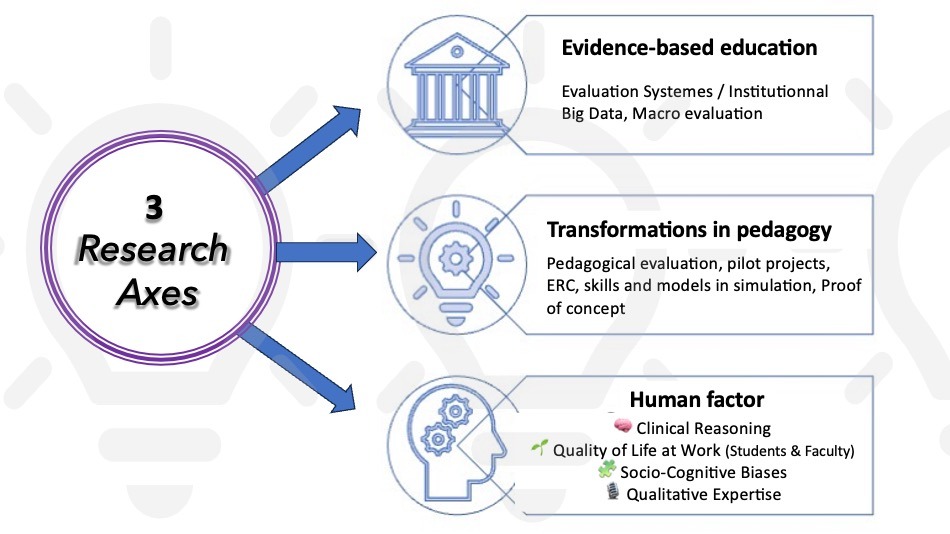
Research Axes
Health education research evaluates the impact of various teaching methods used in health curricula on students’ knowledge and skills. In the long term, it examines how these educational approaches influence the quality of patient care — at the individual, population, and economic levels
Axis 1 : Evidence based EDUCATION
- This research axis aims to evaluate both qualitatively and quantitatively the impact of teaching practices within health education curricula.
- It includes the analysis of curriculum reforms (through longitudinal and systemic evaluations) as well as the assessment of new evaluation methods.
Axis 2: INNOVATIONS in Health education
-Digital tools, AI, simulation, online teaching, podcasts, OSCEs, or Problem-Based Learning — all new tools and pilot projects implemented in health education curricula should be subject to both quantitative and qualitative evaluation.
– The goal is to better understand how these innovations contribute to shaping the practice of tomorrow’s healthcare professionals
Axis 3: the HUMAN FACTOR
Because no two teachers, no two students, and no two patients are the same 🙂 This axis explores the rational analysis of the human factor in learning, and how it influences future clinical practice.
It draws on the recognition that individuals have different patterns of memory, recall, and lived experience, both in practical training and in their overall educational journey.
Key topics include:
– Clinical reasoning
– Quality of life at work (for students and educators)
– Socio-cognitive biases
– Qualitative expertise
Facts and Figures
Affiliated researchers
Projects and grants submitted including 1 ANR
Academic Divisions in Health Discipline
Agenda
 Congrès SoFraSimS 2027
 Partnerships